The Me 163A V4 was shipped to Peenemünde to receive the HWK RII-203 engine in May 1941. By 2 October 1941, the Me 163A V4, bearing the radio call sign letters, or Stammkennzeichen, "KE+SW", set a new world speed record of 1,004.5 km/h (624.2 mph), piloted by Heini Dittmar, with no apparent damage to the aircraft during the attempt.
Showing posts with label Aircraft. Show all posts
Showing posts with label Aircraft. Show all posts
Friday, 13 January 2017
Me-163 A-V4 - Prototype Komet interceptor aircraft in a field
The Me 163A V4 was shipped to Peenemünde to receive the HWK RII-203 engine in May 1941. By 2 October 1941, the Me 163A V4, bearing the radio call sign letters, or Stammkennzeichen, "KE+SW", set a new world speed record of 1,004.5 km/h (624.2 mph), piloted by Heini Dittmar, with no apparent damage to the aircraft during the attempt.

Tuesday, 3 January 2017
Sunday, 1 January 2017
Tuesday, 20 December 2016
8.8cm flak mounted on a Vomag Omnibus 7

An interesting photo as the Vomag Omnibus 7 was a civilian transport vehicle. There isn't a lot of information available about the Omnibus 7.
The variant is known as the Vomag 88mm Flak 18 Waffentrager. It is an example of the need to get such an excellent but horribly immobile weapon into battle and as maneuverable as possible.
Thursday, 8 December 2016
"A date that will live in infamy" - Dec 7th 1941
 |
| The USS Arizona burns during the attack on Pearl Harbor |

"The attack commenced at 7:48 a.m. Hawaiian Time. The base was attacked by 353 Imperial Japanese fighter planes, bombers, and torpedo planes in two waves, launched from six aircraft carriers. All eight U.S. Navy battleships were damaged, with four sunk. All but the USS Arizona (BB-39) were later raised, and six were returned to service and went on to fight in the war. The Japanese also sank or damaged three cruisers, three destroyers, an anti-aircraft training ship, and one minelayer. 188 U.S. aircraft were destroyed; 2,403 Americans were killed and 1,178 others were wounded. Important base installations such as the power station, shipyard, maintenance, and fuel and torpedo storage facilities, as well as the submarine piers and headquarters building (also home of the intelligence section) were not attacked. Japanese losses were light: 29 aircraft and five midget submarines lost, and 64 servicemen killed. One Japanese sailor, Kazuo Sakamaki, was captured.
The attack came as a profound shock to the American people and led directly to the American entry into World War II in both the Pacific and European theaters. The following day, December 8, the United States declared war on Japan. Domestic support for non-interventionism, which had been fading since the Fall of France in 1940, disappeared. Clandestine support of the United Kingdom (e.g., the Neutrality Patrol) was replaced by active alliance. Subsequent operations by the U.S. prompted Nazi Germany and Fascist Italy to declare war on the U.S. on December 11, which was reciprocated by the U.S. the same day.
There were numerous historical precedents for unannounced military action by Japan. However, the lack of any formal warning, particularly while negotiations were still apparently ongoing, led President Franklin D. Roosevelt to proclaim December 7, 1941, "a date which will live in infamy". Because the attack happened without a declaration of war and without explicit warning, the attack on Pearl Harbor was judged by the Tokyo Trials to be a war crime."
https://en.wikipedia.org/wiki/Attack_on_Pearl_Harbor
Wednesday, 7 December 2016
A Douglas A-20 making a bomb run on D-Day, 6 June 1944
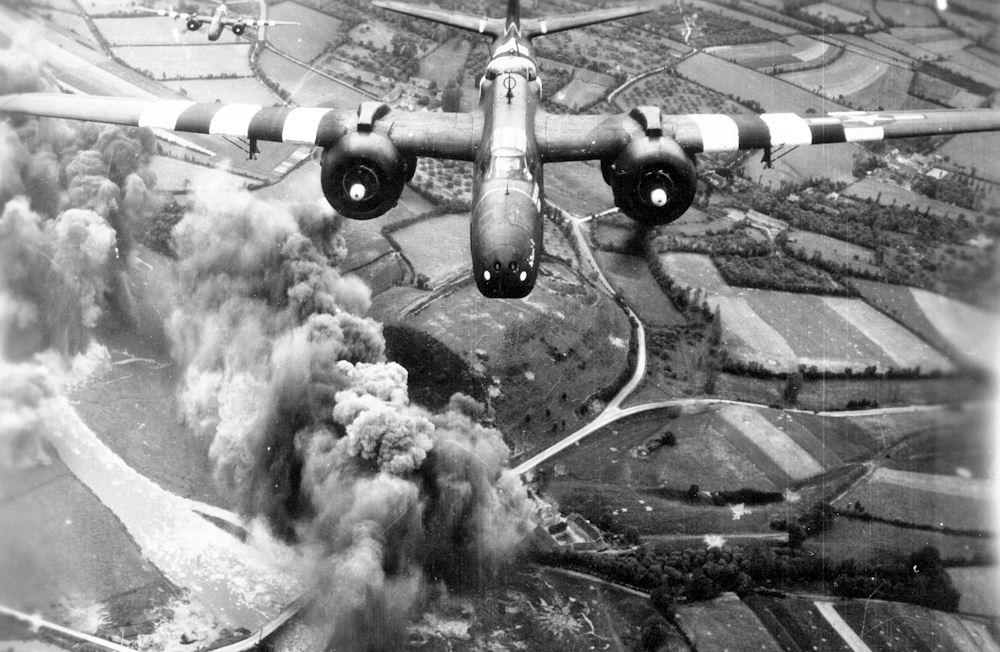
D-Day invasion stripes were removed from the upper surfaces of aircraft a month later, and by the end of 1944 they were completely removed.
Wednesday, 30 November 2016
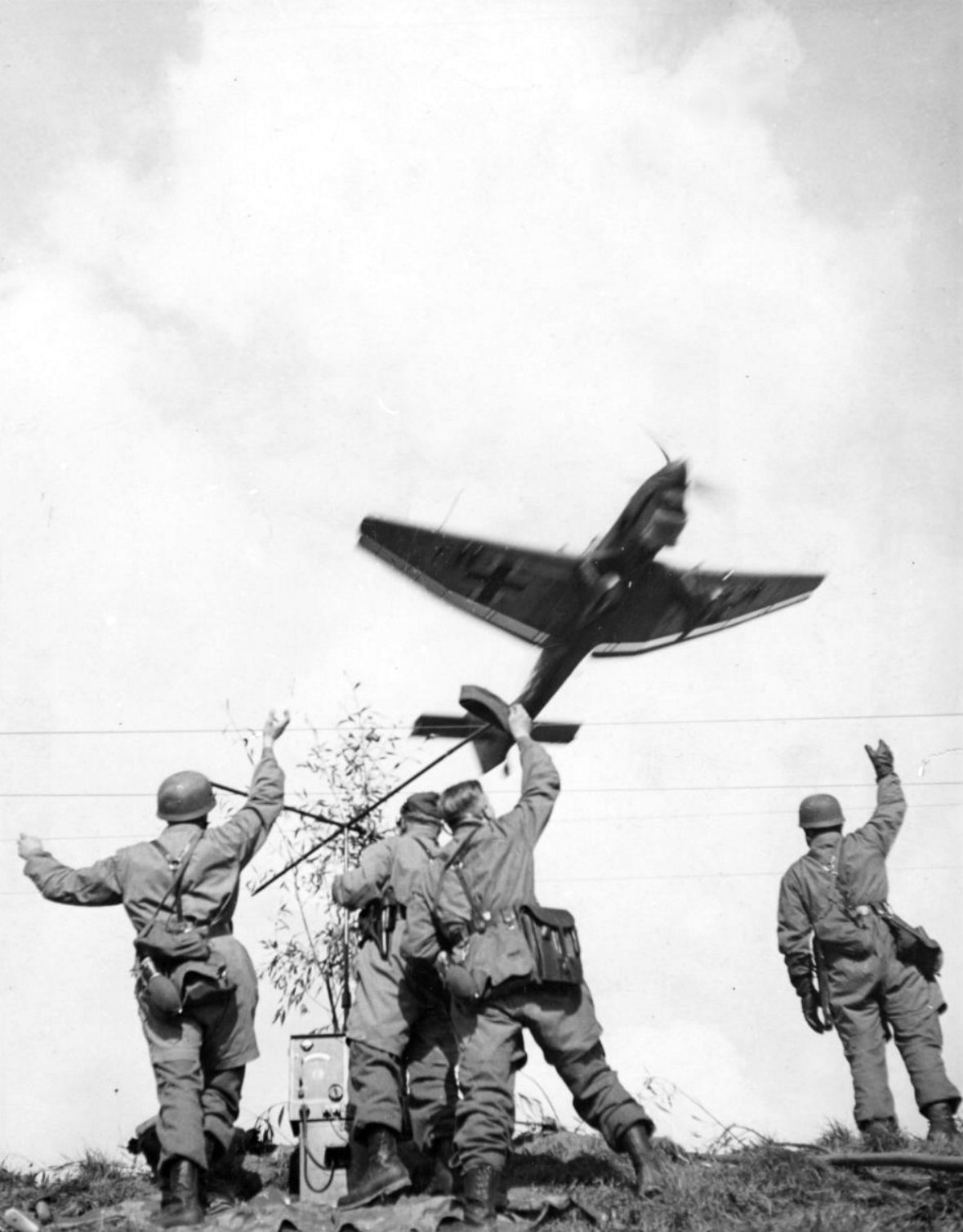
Luftwaffe Fallschirmjäger's wave at a Stuka overhead - May 1940
Tuesday, 29 November 2016
Heinkel He162 Plane Factory in a Salt Mine near Schönebeck 1945

The He 162 Volksjäger - Peoples Fighter, primarily made of wood due to the short supply of metals at this late point in the war.
It was the fastest of the first generation of jet fighters produced during the second world war.
Saturday, 26 November 2016
A row of destroyed "Hanomags" - France 1944

These particular half tracks were knocked out by Allied air power between Carrouges and Rânes - an area below Caen and roughly a 12 km stretch of road. There were two other attacks around the same time which eliminated the entire group.
Thursday, 24 November 2016
RAF Pilot receiving a haircut in between sorties

Monday, 21 November 2016
Ju 88G W7+ N of the Nachtjagdgeschwader 100
 |
| Hungary 1944 |
 |
| Nachtjagdgeschwader 100 |
Subscribe to:
Posts (Atom)